Transformers drive voltage conversion across today’s critical infrastructure, from renewable energy grids to EV charging stations. The choice between step-up and step-down units directly impacts system efficiency, safety, and operational costs. Design engineers must understand how these components fit specific application requirements.
MPS Industries specializes in designing and manufacturing custom magnetic components, including high-performance transformers and inductors. As a leading provider of magnetic solutions, we deliver engineered components tailored to meet the rigorous demands of the automotive, industrial, and renewable energy sectors.
Learn more about step-up transformers, step-down transformers, and the key technical differences in turns ratio and wire gauge selection.
What is a Step-Up Transformer?
A step-up transformer increases electrical voltage by transferring energy from an input coil (the primary winding) to one or more outputs (secondary windings). Power companies rely heavily on these units to efficiently transfer electricity over long distances. This voltage increase reduces the current’s strength, which minimizes energy loss during transmission across the power grid.
The transformer achieves this through electromagnetic induction within a magnetic core circuit, typically made of iron. In this configuration, the secondary winding has more turns than the primary. For example, a step-up transformer can increase voltage from 220V to 11,000V or greater. Industrial renewable energy systems utilize this conversion to feed power into utility grids effectively. Common applications include:
- Solar and wind power generation
- Industrial facility grid interconnection
- Long-distance power transmission substations
- High-voltage test equipment
What is a Step-Down Transformer?
A step-down transformer reduces voltage from the primary to the secondary winding. These components take high-voltage power from the grid and reduce it to safer, usable levels for household appliances, electronics, and industrial equipment.
In a step-down design, the primary winding has more turns than the secondary winding. This creates a voltage decrease proportional to the turns ratio. These units can decrease voltage from 220V down to 110V, 24V, 20V, or even lower, depending on the specific application needs. Applications include:
- Data center power distribution
- EV charging station voltage conversion
- Manufacturing facility power supplies
- Building electrical distribution systems
Key Differences Between Step-Up and Step-Down Transformers
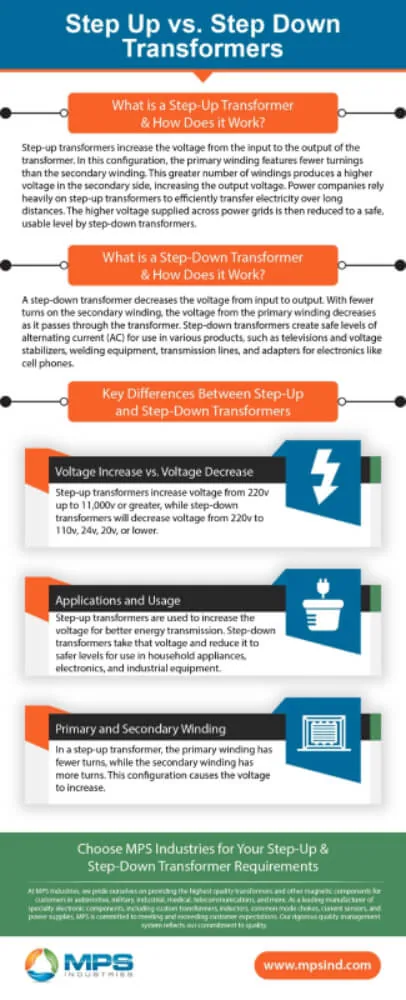
The Turns Ratio
The turns ratio determines the transformation type and magnitude. It represents the mathematical relationship between primary (Np) and secondary (Ns) winding counts:
The number of times the wire wraps around the core, known as the turns ratio, dictates the transformer type. The primary difference lies in whether the device increases or decreases the voltage level:
- Step-up transformer. The secondary winding has more turns, increasing the voltage from 220V up to 11,000V or higher.
- Step-down transformer. The secondary winding has fewer turns, decreasing the voltage from 220V to levels like 110V or 24V.
Voltage transformation follows the turns ratio directly, while current strength follows the inverse. This reciprocal relationship maintains the required power balance across the circuit.
Current Reciprocity and Wire Gauge Selection
Beyond the number of turns, the thickness of the insulated copper wire is a critical design factor. In a step-up transformer, the primary winding is often composed of thicker wire to handle the higher input current, while the secondary winding uses thinner wire.
The opposite is true for step-down transformers. These units use thick insulated copper wire in the secondary winding because that side carries the higher output current. MPS Industries accounts for these specific thermal and electrical requirements when designing custom magnetic hardware. All products adhere to strict quality standards and are manufactured under ISO 9001:2015 certified processes.
Partner with MPS Industries for Custom Transformer Solutions
Selecting between step-up transformers and step-down transformers requires understanding your system’s voltage, current, and power requirements. MPS Industries engineers custom transformers for renewable energy, EV infrastructure, industrial automation, and data center applications. Our design team works from specification through production to deliver components that meet exact electrical and thermal performance targets.
Contact us to discuss your transformer requirements.